

How NetiyaPath works
How it works · Four steps
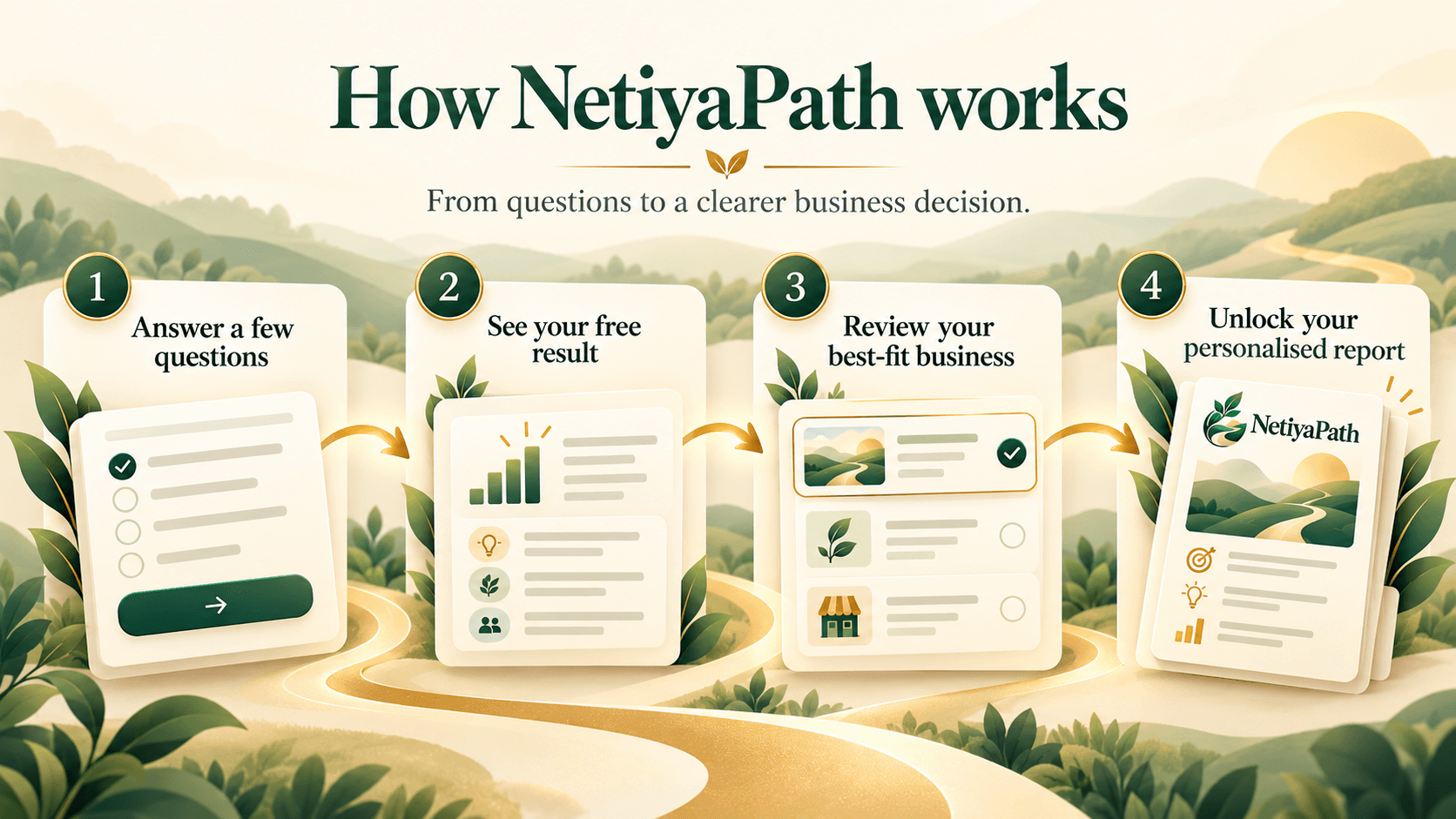
From questions to a clearer business decision — each step in plain words below.
1. Tell us about you
Answer a short set of questions about your budget, available time, skills, preferred way of working and what you want from the business.
2. See your result
If you are looking for ideas, NetiyaPath shows your strongest match and only the alternatives that add something useful to the comparison. If you already have an idea, that idea stays at the centre of the assessment.
Your result is saved so you can come back to the same assessment rather than start again.
3. Review your business fit
You will see why the business was shown — or how your own idea fits your answers — what is already known about it, what could make it a poor fit and what still needs checking.
4. Go deeper if you want
The optional US$29 Personalised Business Report takes the exact result shown before checkout and adds deeper evidence, practical barriers, a business-specific first-customer route and a personalised 12-week roadmap.
US$29 one-off payment · No subscription · 7-day refund
Your result
How many matches you will see
NetiyaPath shows one primary match and, where there are genuinely useful alternatives, up to four alternatives. We do not add weaker ideas simply to fill a list.
Your own idea remains the primary assessment. Alternatives are shown only if you asked to see them.
The AI's rules
Yes, your guide is AI. Here are the rules it lives by.
- 1.It only writes with real numbers — your business type's actual catalog costs and income, and your own quiz answers. It cannot invent a dollar figure, and every response is checked before you see it.
- 2.It doesn't guess at state-specific facts. We don't yet have a verified registry of exact filing fees, forms and deadlines for every state — that's next. Until it exists, the AI stays general on those specifics and tells you to check the official source.
- 3.It knows its limits. Specific tax elections, legal disputes, licensed-profession territory: it explains the concept, declines the decision, and tells you when to bring in a professional.
- 4.When it's not sure, it says so — plainly, not with a confident guess.